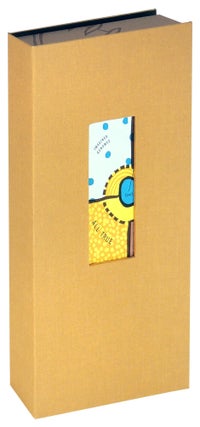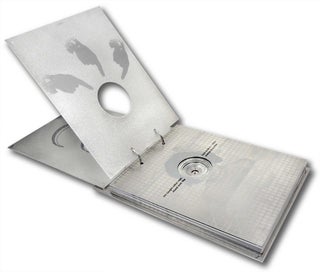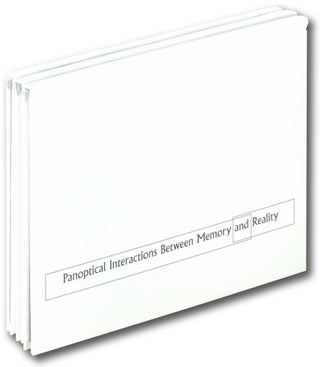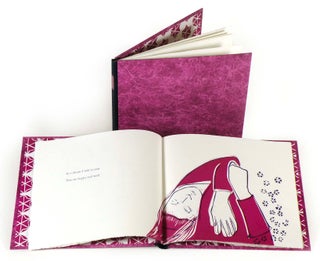
Tuscon, AZ: Troctopus, 2024. Hardcover. Number 2 of 15 copies. According to the book artists: "'Arrhythmia' is a collaborative artist book by Alain Co and Emiland Kray. The content of this book explores the clinging nature of past trauma and how those cycles persist within the lived realities of each artist. Pulled directly from the journals of Co and Kray, the text within this book shows hopelessness, violence, loneliness, worry, and fear in their most vulnerable states. This book was created with the intention that sharing these inner monologues could be a moment of recognition and comradery for individuals who suffer the same thoughts, harmful patterns, and compulsions. The book’s size is a testament to this. Arrhythmia can fit within the palm of your hand and can be cradled by the pressure from your fingers as they wrap around it. The preciousness of these thoughts and the preciousness of this object go hand-in-hand. Furthermore, the bronze cast slipcase will change color due to oxidation the more it is handled with bare skin. Meaning that this piece’s color will become richer and more nuanced if given physical affection over time, just as we strive to do as humans to each other everyday. This artwork through rawness and horrific honesty gives readers a chance to receive that vulnerability with firm acceptance and love."
They continue: "In line with the attachment theory in the field of Childhood psychology, the type of love that was modeled to us by our parents while we were children is formulaically how each child continues to model love throughout their lives as they grow up. When a familial system models behaviors such as neglect, physical and/or mental abuse, or emotional instability, that is the framework from which the child develops under and bases all future relationships upon. This developmental framework is part of what defines the attachment theory at large that describes 4 main attachment styles: healthy attachment, anxious attachment, avoidant attachment, and disorganized attachment. This book draws upon that research and shows, rather than tells, what it feels like to have developed unhealthy attachment styles due to past trauma. In addition to sharing the thoughts of the artists associated with their attachment patterns, it also shows us the ways in which we can heal and cope through community and love. Research shows that consistent communication with healthcare professionals and healthy communication with one’s own community is instrumental in rewiring the brain to recognize past attachment patterns as unhealthy and be flexible and accepting towards learning and adopting new attachment patterns. Arrhythmia consolidates all of this into an experience that readers can hold in the palm of their hands."
A miniature book bound in Asahi silk covered boards with navy blue Moroccan leather spine. Raised bands to spine and embossed design to front board. Letterpress printed on French Paper with inkjet detailing at Bett's printing Co. This project was created on the traditional lands of the Tohono O' odham, Yaqui, Pennacook, Abenaki, and Wabanaki peoples. Housed in a broze cast slipcase, which was cast at the University of New Hampshire in Durham. Book size: 3 x 1.5 inches. Case size (with book inserted): 3.25 x 1.75 x .75 inches.
Arizona based book artist Emiland Kray says about his work: "My artwork poses questions about the mechanics of how we remember – the complexity that exists within those entangled systems. I visually introduce instances of slippage in our recollection of the past and the decay of memory towards nostalgia. Through my work, I gather and sift through intangible archives: dreams, nightmares, and memories themselves to find how these essences make statements about the importance of memory but also the futility and temperance of life. I use the systems of remembering hidden within the body to make statements about identity, fear, and longing but also to search for the morphology of nostalgia. With a combination of watercolor, ink, game design, and book arts I create tension between the real and the surreal and uncanny. This combination disrupts the recognizability of the archive and thus also disrupts the stability and the seductive nostalgic essence of the past. These techniques pose the past as questionable, memory as simulation, and evidence as incomplete. My work seeks to make visible our growing pains and to reject comfort in the notion of a perfect genesis." ARTB/050925. Fine. More